
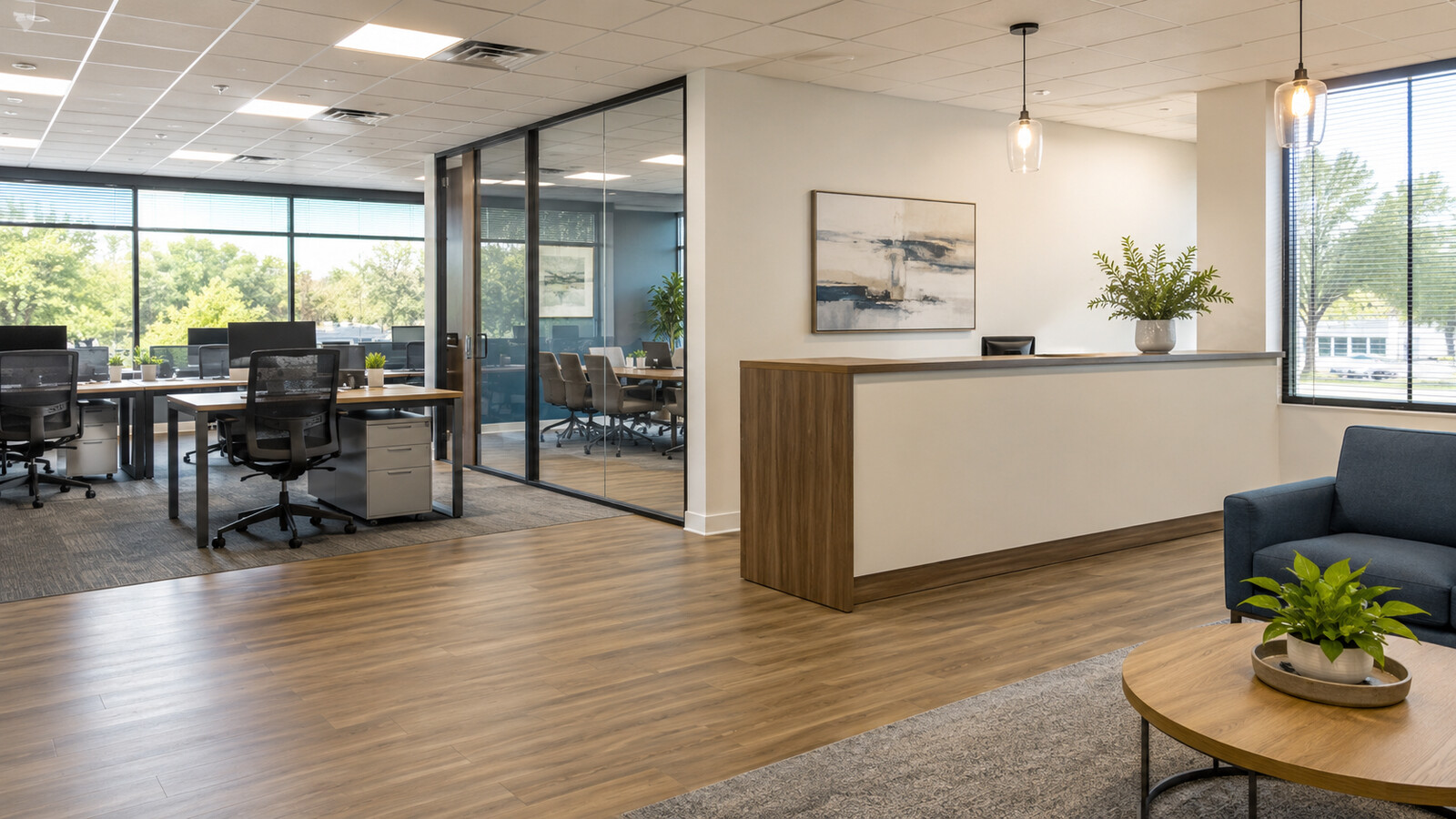
An effective office cleaning checklist covers reception areas,
accessible work surfaces, high-touch points, restrooms, break rooms,
trash and recycling, carpets, hard floors, and shared spaces. The final
checklist should match the office’s traffic, layout, access rules,
condition, and service frequency—not a generic list copied from another
building.
Use the checklist below to identify priorities, assign
responsibilities, and build a clear scope before cleaning begins. If you
would rather have a trained local team manage the work, review Tidy
Upped’s office
cleaning service in Allen and nearby North Dallas communities.
Office cleaning
checklist: quick version
Reception and entry areas
Workspaces and private
offices
Conference rooms and shared
spaces
Restrooms
Break rooms and kitchenettes
Floors, trash, and final
check
Keep
cleaning, sanitizing, and disinfecting distinct
Routine cleaning, sanitizing, and disinfecting are different steps.
State only the step that is actually included in the approved scope.
When a sanitizer or disinfectant is used, clean the surface first when
required and follow the product label for the approved surface, dilution
or application method, safety directions, and contact time. See current
CDC
cleaning and disinfecting guidance and EPA
disinfectant-label guidance.
Start with the office’s
real priorities
Two offices with the same square footage may need very different
cleaning plans. A client-facing professional office with steady visitors
may place more emphasis on reception areas, restrooms, conference rooms,
and floors. A smaller office with limited visitor traffic may focus on
workspaces, trash, break rooms, and a dependable recurring schedule.
Before setting the checklist, identify:
- The approximate square footage and layout
- Employee count and normal visitor traffic
- The number of restrooms and food areas
- Carpet, hard flooring, and other surface types
- Client-facing and high-priority areas
- Trash and recycling locations
- Restricted rooms, equipment, papers, and personal work areas
- Parking, entry, keys, codes, alarms, elevators, and loading
requirements - Preferred service windows and operating hours
- The current condition and the standard that should be
maintained
These details prevent assumptions from becoming service problems.
They also help the office and cleaning team agree on what is included
before the first visit.
How often should an
office be cleaned?
There is no single schedule that fits every workplace. Cleaning
frequency depends on employee count, visitors, restroom use, food areas,
flooring, operating hours, current condition, and the standard the
business wants to maintain.
For a fuller comparison of daily, two-to-three-times-weekly, and weekly service, see how often an office should be professionally cleaned.
Use this planning framework instead of treating it as a fixed
prescription:
| Service level | Items to evaluate | When it may fit |
|---|---|---|
| Every scheduled visit | Trash, high-touch points, restrooms, break rooms, reception, visible floors, and other agreed priorities |
Areas that affect daily employee or visitor experience |
| Rotating detail work | Accessible dusting, less-used rooms, edges, ledges, and other items that do not need the same attention every visit |
Offices using a written rotation to control scope and cost |
| Periodic or separately quoted work | Initial cleaning, carpet cleaning, window cleaning, deeper floor work, and other specialty tasks |
Work outside the recurring office checklist or needed only at intervals |
The best schedule is the one that maintains the agreed standard
without leaving important areas vague. Tidy Upped evaluates the office,
priorities, access, and preferred timing before recommending a plan.
Define access
and security before cleaning day
An office checklist is incomplete without access instructions. The
cleaning team may need to know where to park, which entrance to use, how
keys or codes are managed, when alarms are active, and which rooms are
restricted.
Confirm these points in writing:
- Approved service days and time window
- Daytime or after-hours access
- Keys, codes, badges, alarms, and lock-up steps
- Parking, loading, elevator, and front-desk instructions
- Restricted rooms or confidential work areas
- Rules for desks, papers, computers, and personal belongings
- Who to contact if access or scheduling changes
- How service concerns should be reported and resolved
Clear access planning protects both the office and the cleaning team.
It also reduces delays and prevents employees from having to manage the
same instructions repeatedly.
Separate
recurring work from periodic services
A recurring office plan should state what happens during a normal
visit. Periodic or specialty work should be listed separately so no one
assumes it is automatically included.
Possible separately scheduled services may include initial or
one-time commercial cleaning, carpet cleaning, window cleaning, vacant
commercial move-in or move-out cleaning, and construction or renovation
cleaning. Each has different equipment, timing, and estimating
factors.
If the property is not a traditional office—such as a retail,
wellness, fitness, leasing, religious, or other shared facility—review
Tidy Upped’s broader commercial
cleaning services instead of forcing the property into an
office-only checklist.
Build accountability
into the checklist
The checklist should make the service easier to manage, not create
another administrative task. A practical plan identifies the approved
scope, service window, access process, and main contact before work
starts.
For each recurring plan, confirm:
- Which areas and tasks are included
- Which items are excluded or handled by office staff
- Which tasks rotate instead of happening every visit
- What requires separate approval or pricing
- How schedule or access changes are communicated
- How a missed priority or service concern is reported
- Who can approve changes to the scope
This creates one shared reference for the office manager and cleaning
team instead of relying on memory, informal requests, or conflicting
instructions.
Office cleaning checklist
FAQ
What
should be included in an office cleaning checklist?
An office cleaning checklist commonly covers reception areas,
accessible work surfaces, high-touch points, restrooms, break rooms,
trash and recycling, vacuuming, mopping, and shared spaces. The final
list should identify the exact rooms, tasks, frequency, exclusions,
access rules, and communication process approved for that office.
How often should a
small office be cleaned?
Frequency depends on employee count, visitors, restroom and
break-room use, flooring, operating hours, current condition, and the
standard the office wants maintained. A defined quote and scope review
can help determine which priorities belong on every visit and which can
rotate or be scheduled periodically.
Can office
cleaning happen after business hours?
After-hours cleaning may be available when the requested schedule
fits team availability and the office provides clear access, alarm,
parking, security, and lock-up instructions. Share the preferred service
window during the quote process so the cleaning company can evaluate the
fit.
Will
cleaners move papers or personal items on desks?
Accessible surfaces can be included, but papers, personal items,
electronics, and restricted areas need clear rules. The office should
define what may be moved or touched and what must remain undisturbed
before service begins.
What
affects the price of professional office cleaning?
Pricing can depend on square footage, layout, facility type, current
condition, cleaning frequency, restrooms, break rooms, flooring, trash
needs, access requirements, requested tasks, and specialty services. A
defined scope is necessary for an accurate quote.
What
is the difference between office and commercial cleaning?
Office cleaning is designed around traditional workspaces, reception
areas, conference rooms, restrooms, break rooms, floors, and shared
office areas. Commercial cleaning is a broader category that may cover
retail, wellness, fitness, leasing, religious, and other eligible local
facilities with different operating and access needs.
Request an
office cleaning plan from Tidy Upped
Tidy Upped provides customized office cleaning for eligible small and
midsize offices in Allen, Plano, Frisco, McKinney, and nearby North
Dallas communities. Plans are built around the workplace, priorities,
access, service window, and standard the business needs maintained.
Review the Office Cleaning
service page or request
a customized cleaning quote with the office size, requested
frequency, access details, priority areas, and preferred timing.

Leave A Comment