
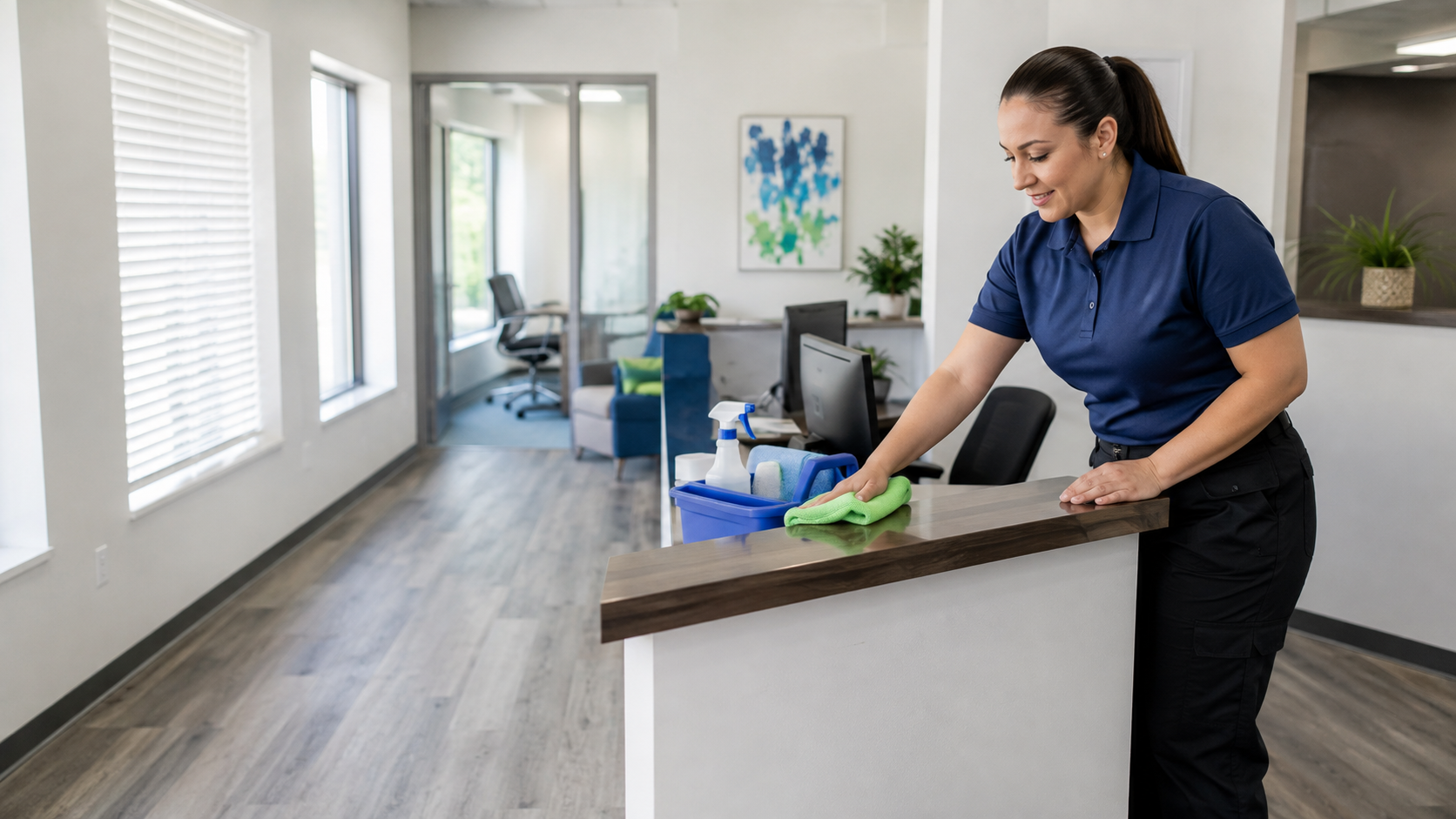
There is no single cleaning frequency that works for every office. A quiet professional suite with six employees has different needs from a busy reception area, salon, gym, retail space, or medical office. The most useful approach is to match the schedule to how quickly each area becomes visibly or hygienically difficult to maintain.
A professional cleaning plan should also separate routine recurring work from occasional detailed tasks. That prevents a weekly checklist from becoming overloaded while still giving floors, restrooms, workspaces, and shared areas the attention they need.
Office cleaning frequency by workplace use
| Typical frequency | Often fits | Common priorities |
|---|---|---|
| Five or more visits per week | High-occupancy offices, busy customer-facing spaces, facilities with heavily used shared restrooms or break rooms | Trash, restrooms, touchpoints, break-room surfaces, entries, visible floors, and rapid issue reporting |
| Two to three visits per week | Moderately busy professional offices, growing teams, spaces with regular visitors or shared amenities | Restroom consistency, waste removal, dust control, vacuuming, mopping, reception, and shared rooms |
| One visit per week | Small, lower-traffic offices with limited visitors and responsible daily staff upkeep | Whole-office reset, restrooms, floors, dusting, kitchen or break-room surfaces, and wastebaskets |
| Periodic detailed service | Any workplace that already has recurring cleaning | Baseboard buildup, higher dust, interior glass, carpet cleaning, floor detail, or other approved project work |
These are planning ranges, not rigid rules. Some businesses divide the work: high-use areas receive attention more often while private offices or low-use rooms rotate on a lighter schedule. A walkthrough and a clear office cleaning checklist are better starting points than choosing a frequency from square footage alone.
What determines how often an office should be cleaned?
Occupancy and daily traffic
More people bring more floor soil, fingerprints, waste, restroom use, and shared-surface contact. Consider both the employee count and how many clients, vendors, patients, members, or guests enter the space.
Restrooms and break rooms
Shared restrooms and food areas often determine the minimum useful frequency. A lightly used office may look orderly while these rooms still need more regular attention.
Floor type and weather
Carpet, hard flooring, entry mats, rain, construction nearby, and parking conditions affect how quickly soil travels through a workplace. Entries and main paths usually show it first.
Business type and expectations
A customer-facing reception area, medical office, salon, gym, or retail space usually has different presentation and cleaning priorities than a private administrative suite.
Operating hours and access
Long hours, evening activity, alarm procedures, keys, building rules, and limited service windows influence both frequency and what can be completed during each visit.
Current condition and scope
Recurring service is designed to maintain a workable baseline. Heavy buildup, renovation dust, neglected floors, or an overfilled first checklist may require a separate initial or detailed service.
How often should specific office areas be cleaned?
One schedule does not require every task to happen at the same interval. A practical scope prioritizes the areas that change fastest and assigns less frequent work intentionally.
- Restrooms: inspect and clean based on actual use. Busy shared restrooms may need service every business day, while a small office with limited use may need fewer professional visits.
- Break rooms and kitchens: clean counters, sinks, appliance exteriors, tables, and floors often enough to control crumbs, spills, residue, and odors. Employees should still address immediate spills and food-storage issues.
- Reception and lobby areas: keep entries, glass, visible surfaces, seating, and main floors consistent with the volume of visitors and the impression the business wants to make.
- Workstations and private offices: schedule dusting, waste removal, and accessible-floor care around privacy rules, desk clutter, employee presence, and the agreed scope.
- Conference rooms: match cleaning to meeting frequency, food service, and visitor use rather than treating an occasionally used room like a daily priority.
- Floors: vacuum or mop traffic paths often enough to prevent visible soil from spreading. Carpet extraction, detailed edge work, and specialty floor care are separate from routine vacuuming and mopping.
Frequency guidance for different commercial spaces
Professional and administrative offices
A small professional office may do well with weekly or two-to-three-times-weekly service. The deciding factors are usually restroom use, team size, visitors, break-room activity, and the desired presentation standard. Larger teams and shared suites tend to need more frequent attention.
Medical and dental offices
Medical offices should set frequency around patient volume, room use, facility policies, and applicable requirements. Routine professional cleaning may cover waiting rooms, administrative areas, staff spaces, restrooms, floors, and agreed non-clinical surfaces. Clinical disinfection protocols, sharps, regulated waste, bodily fluids, and other specialty hazards require appropriately trained providers and a separately defined scope. Our medical office cleaning checklist helps facility managers document routine priorities without confusing them with clinical responsibilities.
Retail, salons, gyms, and customer-facing spaces
Customer traffic and visible presentation often push these spaces toward more frequent service. Entries, floors, restrooms, mirrors or glass, checkout or reception areas, and shared touchpoints may need attention several times per week or daily. Equipment-specific sanitation and industry-regulated procedures should remain clearly assigned.
Lobby and common areas
Common spaces can collect traffic from several offices even when individual suites remain quiet. Property managers should evaluate total building use, shared restrooms, elevator or stair access, entries, and who is responsible for each boundary.
Recurring office cleaning vs. periodic deep cleaning
Recurring office cleaning handles the repeatable work that keeps an established baseline consistent: wastebaskets, restrooms, break rooms, reachable dusting, vacuuming, mopping, reception areas, and other agreed priorities. A periodic detailed service addresses work that does not belong on every visit.
That periodic work may include detailed baseboards, accumulated high dust, interior glass, carpet cleaning, floor-edge detail, cabinet interiors, or an initial reset. Renovation or construction dust also requires separate planning because fine particles can settle repeatedly and may require specialized sequencing.
Separating these service types keeps the recurring checklist realistic. It also makes performance easier to evaluate: the client and cleaning team can see whether routine tasks were completed without mixing them with occasional projects.
Signs your office cleaning schedule is too light
- Restrooms become visibly untidy or run low on agreed supplies before the next visit.
- Trash, food residue, or odors accumulate in break rooms and shared spaces.
- Entry floors and main traffic paths look soiled for much of the week.
- Dust becomes visible on reachable surfaces between scheduled cleanings.
- Employees or managers repeatedly perform substantial cleaning to bridge the gap.
- Client-facing areas no longer match the image the business wants to present.
- Each visit requires catch-up work that prevents completion of the normal scope.
More frequency is not always the only answer. The scope may be unclear, the first service may not have established a baseline, access time may be too short, or one high-use area may need a different interval. Documenting the pattern makes the next adjustment more precise.
How to choose a practical office cleaning schedule
Start with a walkthrough and answer five questions: How many people use the space? Which rooms change fastest? What must look ready for customers or staff each day? What light upkeep will employees handle? Which tasks are periodic rather than recurring?
Then build a defined scope with responsibilities, frequency, access instructions, restricted areas, floor priorities, waste procedures, and communication expectations. Review the plan after the first few visits. Actual use is more reliable than assumptions, and a schedule can be adjusted when occupancy, seasons, operating hours, or room use changes.
A professional commercial cleaning service should explain what will be completed on each visit, what rotates, and what requires separate approval. That clarity matters as much as the number of weekly visits.
Office cleaning in Allen and North Dallas
Tidy Upped provides recurring office and commercial cleaning for professional offices, medical offices, retail spaces, salons, gyms, lobby and common areas, and smaller commercial facilities. We focus on trained employees, a defined scope, centralized communication, and schedules built around the space rather than a one-size-fits-all checklist.
Service is available in Allen, Plano, McKinney, Frisco, Richardson, Fairview, Lucas, Parker, Prosper, Carrollton, The Colony, Little Elm, Murphy, Wylie, Sachse, Garland, and nearby North Dallas communities. A walkthrough or detailed quote conversation helps us recommend a realistic frequency and identify any starting or periodic work.
Frequently asked questions
Is weekly office cleaning enough?
Should an office be professionally cleaned every day?
How often should office restrooms be cleaned?
How often should office carpets be professionally cleaned?
Can office cleaning happen after business hours?
What information is needed for an office cleaning quote?
Build an office cleaning schedule around your space
Tell us about your workplace, traffic, priorities, access, and preferred service days. Tidy Upped will recommend a practical recurring scope and identify any initial or periodic work separately. Request your free commercial cleaning quote →

Leave A Comment