
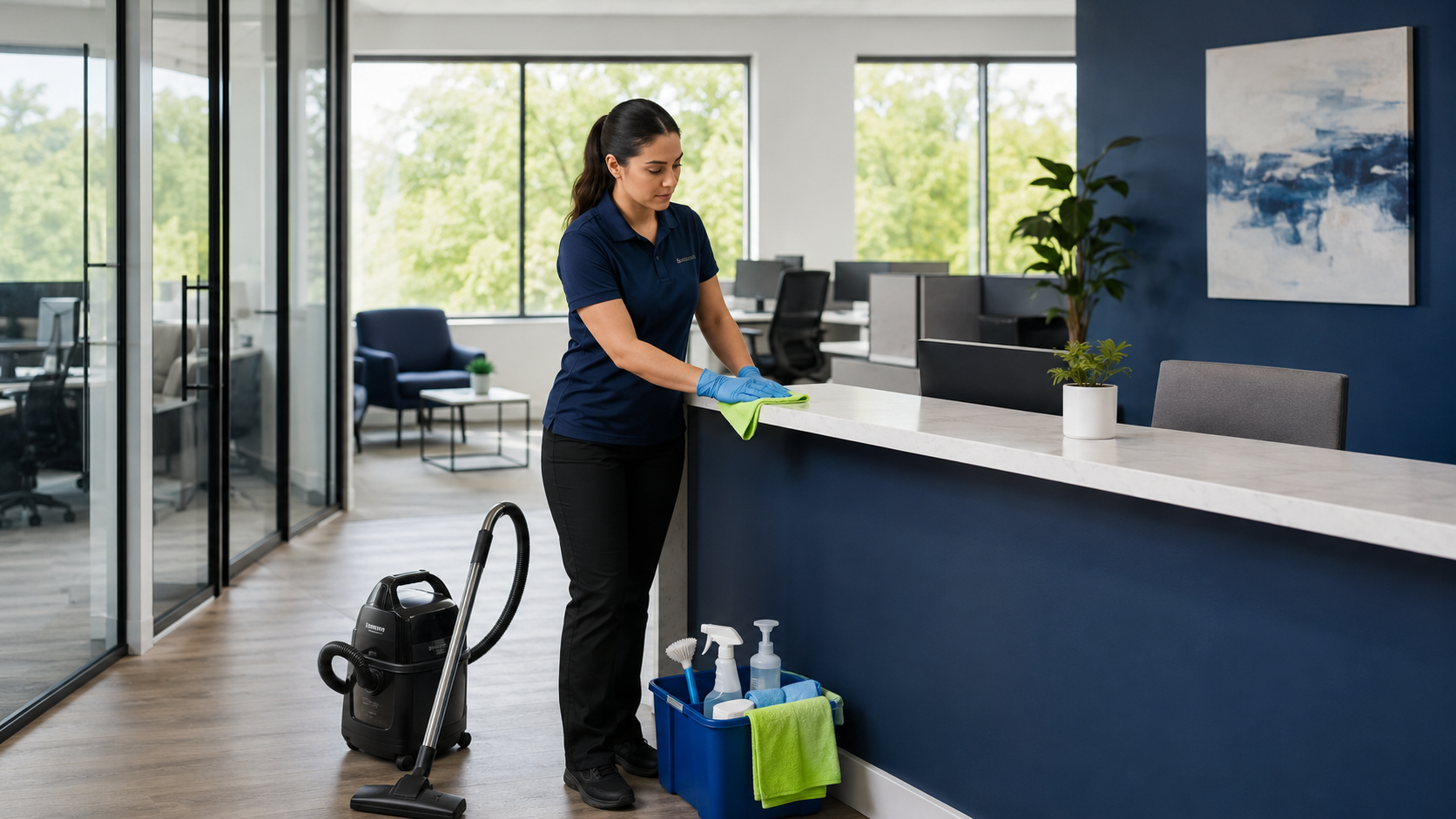
A small professional office that needs cleaning two evenings per week has very different requirements from a large building that needs attendants throughout the business day. Both may search for “commercial cleaning” or “janitorial service,” but they should not automatically receive the same recommendation.
Understanding the distinction helps business owners, office managers, medical-office administrators, and property contacts compare providers more accurately. It also helps prevent paying for a staffing model the facility does not need—or choosing a light schedule when ongoing daytime attention is required.
Commercial cleaning vs. janitorial service: the practical difference
Scheduled commercial cleaning
Typical model: A trained cleaning team visits on an agreed schedule, often before or after normal business hours.
- Common for smaller offices and professional spaces
- May be scheduled weekly, several times per week, or another agreed frequency
- Follows a defined recurring scope
- Can include separate detailed, carpet, window, or post-renovation services
Traditional janitorial or day-porter service
Typical model: Routine facility support is provided frequently or continuously during operating hours.
- Often used by larger or high-traffic facilities
- May include restroom checks and trash service throughout the day
- May include consumable-supply monitoring or restocking
- Can require dedicated on-site staffing and facility-management coordination
These are common patterns, not universal definitions. Some companies use “janitorial” for any recurring office-cleaning contract, while others use “commercial cleaning” for everything from nightly upkeep to specialty projects. Always compare the actual proposal instead of assuming the label guarantees a certain scope.
What does scheduled commercial cleaning usually include?
A recurring commercial cleaning service commonly focuses on the areas employees, clients, patients, and visitors use most. The final plan should reflect the facility, but routine work may include:
- Cleaning accessible desks, counters, reception surfaces, and shared work areas
- Dusting accessible furniture, ledges, fixtures, and décor
- Cleaning breakroom sinks, counters, tables, and appliance exteriors
- Cleaning restroom fixtures, mirrors, counters, and floors
- Emptying agreed wastebaskets and replacing client-provided liners
- Vacuuming open carpeted areas, rugs, and accessible edges
- Vacuuming and mopping accessible hard floors
- Spot cleaning accessible doors, frames, switches, and high-touch surfaces
Our office cleaning checklist provides a more detailed area-by-area reference. The provider should still confirm the exact scope for the specific workplace before service begins.
What may be included in janitorial or day-porter service?
A janitorial or day-porter arrangement may involve tasks that repeat during operating hours rather than only during a scheduled cleaning visit. Examples can include restroom inspections, immediate spill response, continuous lobby attention, trash collection during the day, supply checks, and communication with an on-site facility manager.
That staffing model can make sense for a large building, busy public venue, high-traffic facility, or property that needs someone visibly available throughout the day. It may be unnecessary for a smaller professional workplace that can be cleaned reliably on a scheduled evening, morning, or weekend plan.
Which workplaces are a good fit for scheduled commercial cleaning?
Scheduled cleaning often fits businesses that need dependable recurring service without a full-time attendant. Tidy Upped primarily supports:
- General and professional offices
- Medical, wellness, and administrative offices
- Smaller retail stores and showrooms
- Salons, studios, and smaller gyms
- Reception areas, lobbies, and common spaces
- Smaller commercial facilities with a defined recurring scope
The right plan depends on traffic, operating hours, floor types, restroom use, food preparation, client-facing areas, and how quickly the space changes between visits. A workplace does not need to be a high-rise or large corporate campus to benefit from professional commercial cleaning.
When does a business need day-porter support instead?
Day-porter or dedicated janitorial staffing may be the better fit when the facility needs cleaning attention throughout open hours. Strong indicators include:
- Restrooms or common areas require multiple checks every day.
- Spills and public-facing messes need immediate response.
- Trash must be collected continuously rather than once per visit.
- The property needs on-site supply management or restocking.
- A facility manager expects a dedicated attendant to remain available.
- The building is large enough that scheduled visits cannot reasonably cover the operational need.
Tidy Upped is not primarily positioned as a high-rise day-porter company. When a facility’s requirements depend on continuous staffing, that should be discussed honestly before a proposal is prepared.
How often should a commercial space be cleaned?
There is no universal schedule. A quiet professional office may need service weekly, while a medical office, gym, busy retail space, or heavily used workplace may need cleaning several times per week. Some facilities need selected tasks more often than the rest of the checklist.
Traffic, staffing, restroom use, food and beverage activity, floor type, operating hours, and client expectations all affect the recommendation. See how often an office should be professionally cleaned for a practical frequency framework.
What about medical and professional offices?
Medical and professional offices benefit from a documented scope, clear access instructions, and attention to client-facing and shared areas. However, routine commercial cleaning should not be confused with clinical sterilization, regulated medical-waste handling, or specialized infection-control work unless those services are explicitly qualified and included.
Tidy Upped’s medical office cleaning service focuses on routine facility care for appropriate smaller practices and professional spaces. The service plan should identify restricted rooms, sensitive equipment, access requirements, approved products, and any work that remains the client’s responsibility.
Are specialty commercial projects separate?
Usually. Recurring commercial cleaning maintains the agreed facility baseline, while specialty projects may require different equipment, time, or pricing. Examples include carpet cleaning, interior window cleaning, detailed initial service, and post-construction or renovation cleaning.
Keeping those projects separate makes the recurring scope easier to manage. It also prevents occasional detailed work from displacing the essential tasks the business expects every visit.
Questions to ask before choosing a provider
- Will the proposal list the exact rooms, tasks, and service frequency?
- Are the cleaners employees, subcontractors, or a combination?
- Who provides consumable supplies such as paper goods, soap, and trash liners?
- How are access, keys, alarms, and restricted areas handled?
- What happens when the facility is closed for a holiday or requests a schedule change?
- Are carpet, window, floor-detail, or post-renovation services included or separate?
- Does the provider carry appropriate insurance and have a clear communication process?
- Is the business expecting scheduled cleaning or an attendant available during operating hours?
Frequently asked questions
Is commercial cleaning the same as janitorial service?
The terms overlap, but janitorial service often suggests frequent routine upkeep or on-site support, while commercial cleaning is a broader category that includes scheduled workplace cleaning and specialty projects. The written scope is more reliable than the label.
Does a small office need a janitor?
Not necessarily. Many smaller offices are well served by a professional cleaning team visiting on a defined weekly or multiple-times-per-week schedule. A dedicated janitor or day porter is more useful when the facility needs attention throughout operating hours.
Can commercial cleaners work after business hours?
Often, yes. Many commercial plans are scheduled before opening, after closing, or on weekends. Access, alarms, keys, parking, restricted rooms, and the preferred communication process should be confirmed in advance.
Who supplies paper products and trash liners?
That depends on the contract. Clients commonly provide consumable paper goods, soap, and replacement liners unless supply management is specifically included. The proposal should state who is responsible for purchasing, storing, and restocking them.
Does commercial cleaning include carpet and window cleaning?
Routine vacuuming and spot cleaning may be included, but professional carpet cleaning and detailed window cleaning are commonly separate services. Confirm the frequency, method, and pricing for specialty work before approving the proposal.
How is commercial cleaning priced?
Pricing commonly reflects square footage, layout, condition, frequency, restroom and breakroom use, floor types, access, operating hours, and the confirmed task list. A walkthrough may be needed before the provider can recommend an accurate recurring plan.
Need dependable cleaning for a smaller North Dallas workplace?
Tell Tidy Upped about the facility, schedule, traffic, priorities, and access requirements. We will help determine whether a scheduled commercial-cleaning plan fits the space.

Leave A Comment