
If you forgot to put the trash out, first check your city, hauler, apartment, or HOA collection page. A forgotten set-out is different from a missed collection: if the cart was not presented correctly or on time, do not report that the crew skipped it. Confirm whether you must wait for the next regular pickup or may use an approved extra-pickup, overflow, drop-off, or additional-cart option.
If the cart was correctly placed but was not collected, check for a tag, obstruction, neighborhood delay, holiday change, or active service notice. Follow the official reporting cutoff and instructions. Some cities say to leave a properly placed missed cart out; others tell residents to wait until a stated time or the following day before reporting.
Short answer: verify what happened, follow the official missed-pickup or forgotten-set-out rule, keep ordinary allowed household waste tied and contained in the approved closed cart, separate restricted materials, clean any leaked residue safely, and create an address-based reminder from the current city schedule.
The Moment You Realize You Missed Trash Day
Use this decision sequence before moving bags or filing a request:
- Confirm the day and service. Check the address-based calendar, holiday notice, and current delay page. Trash, recycling, yard waste, and bulky collection may follow different schedules.
- Decide whether it was forgotten or missed. If the cart was not out on time, was blocked, overfilled, facing the wrong direction, contained prohibited material, or had loose bags outside, the hauler may treat it as a set-out problem rather than a missed collection.
- Look for a tag or notice. A tag may explain what must be corrected before the next attempt.
- Check the reporting window. Do not assume the crew is finished early in the day. Cities use different end times and deadlines.
- Follow the official cart instruction. Leave the cart out only when the city or hauler tells you to do so. Otherwise return it to the property’s approved storage location.
- Ask about lawful alternatives. If waiting is impractical, confirm eligibility, accepted material, identification, fees, hours, and transport rules for an extra pickup, transfer station, disposal site, or additional cart.
For an apartment, condominium, shared dumpster, private community, or commercial property, contact the property manager or contracted hauler. City residential rules may not apply.
What Actually Happens When Trash Isn’t Collected
The result depends on what is in the container, how it is bagged, whether the lid closes, the weather, animal access, and how long collection is delayed. Food residue, liquids, damaged bags, heat, and an open or overfilled cart can increase odors, leakage, insects, or animal access. Dry, securely bagged permitted waste in a closed cart may present a different condition.
Avoid fixed claims that every missed pickup creates bacteria, mold, a health hazard, a code violation, or a pest problem within a certain number of hours. Instead, inspect the actual condition:
- Is the lid fully closed?
- Are any bags torn or leaking?
- Is waste outside the approved container?
- Is the cart blocking a sidewalk, alley, street, driveway, mailbox, meter, or another required clearance?
- Is any item prohibited from ordinary household collection?
- Is there a tag, active delay, or weather notice?
If there is a sharp, chemical spill, unknown substance, medical waste, sewage, biohazard, fire risk, or other immediate hazard, keep people and pets away and use the appropriate local emergency, environmental, medical-waste, or specialist guidance. Do not sort or clean an unknown hazard as ordinary trash.
How to Manage Trash Immediately After Missing Pickup
1. Keep permitted household waste contained
For ordinary waste allowed by the local service, keep bags securely tied and inside the approved lidded cart. Do not overfill the cart, force the lid, compact bags by hand, place bags on top or beside the cart, or substitute a contractor bag unless the current service rules explicitly allow it.
Do not move the waste into a garage, shed, cooler, public container, business dumpster, construction container, or another resident’s cart as a universal workaround. Property rules, ventilation, permission, capacity, container ownership, and local codes may prohibit that choice.
2. Separate materials that need another disposal path
Ordinary household trash rules often exclude or separately manage:
- paint, pesticides, solvents, fuel, oil, cleaners, and other household chemicals;
- batteries, electronics, fluorescent lamps, and some appliances;
- hot ashes, propane cylinders, and combustible material;
- medicines, needles, lancets, and other sharps;
- construction debris, concrete, soil, rock, and large metal;
- bulky furniture, mattresses, carpet, branches, and yard waste;
- liquids, sewage, biohazards, and medical waste; and
- anything marked for a special collection program.
The U.S. Environmental Protection Agency’s household hazardous-waste guidance advises keeping household hazardous products in their original labeled containers, never mixing leftovers, following label disposal directions, and checking the local solid-waste or environmental agency for the correct program. A regular cart, transfer station, junk-removal company, or household chemical center may not accept every item.
3. Clean leaked residue without making a broader claim
If an ordinary bag leaks onto a washable, nonporous cart or floor, avoid direct contact, remove the contained waste according to the applicable rule, absorb or remove the visible residue, and clean the surface with water and a suitable soap or detergent. Follow the surface and product instructions.
Cleaning, sanitizing, and disinfecting are different. The CDC’s household cleaning and disinfecting guidance says cleaning is enough in most household situations and that surfaces should be cleaned before sanitizing or disinfecting. If disinfection is appropriate, use an EPA-registered product for the intended surface and purpose and follow its current label for protective equipment, dilution, contact time, ventilation, rinsing, storage, and disposal. Never mix products.
Stop and use specialist guidance for sewage, medical waste, unknown chemicals, pests, extensive contamination, or another condition outside ordinary household cleaning.
4. Use only an authorized disposal alternative
Before transporting waste, verify:
- whether your address is eligible;
- whether an appointment or account is required;
- accepted and prohibited materials;
- quantity, container, and load-covering rules;
- identification, utility-bill, vehicle, and residency requirements;
- fees, hours, and holiday closures; and
- safe transport instructions for the specific material.
Do not rely on an old directory, search snippet, or another city’s rule. Use the current official page or contact listed by your actual service provider.
Alternative Disposal Options When You Miss Trash Day
The correct option may be one of the following, but availability is not universal:
| Option | Confirm before using it |
|---|---|
| Next regular pickup | Cart storage, overflow, extra-bag, and set-out rules |
| Missed-collection request | The cart was on time, compliant, unblocked, and reported within the official window |
| Extra pickup or additional cart | Eligibility, price, scheduling, and accepted materials |
| City drop-off or transfer station | Residency, ID, utility bill, hours, fees, load rules, and material acceptance |
| Bulky-item collection | Appointment, size, quantity, placement, and excluded materials |
| Private licensed hauler | Accepted materials, pricing, transport, disposal, and property access |
| Neighbor’s available capacity | The neighbor’s explicit permission plus city, hauler, HOA, lease, and container rules |
If the underlying problem is bulky unwanted furniture, appliances, debris, or household clutter—not a routine bag missed at the curb—ask whether Tidy Upped’s Junk Removal service accepts the specific items. Do not assume acceptance of chemicals, paint, fuel, batteries, electronics, medical waste, biological material, liquids, sewage, ordinary weekly household trash, or any restricted item. List every item and access constraint when you request a quote.
Trash Day Schedules for Cities in North Texas (TX)
Collection days, holiday rules, set-out times, missed-pickup deadlines, and accepted overflow can change by address and service type. The reviewed official paths below are safer than copying one static schedule into this article.
| City | Current official path | Use it for |
|---|---|---|
| Allen | MyAllen App and Request Center | Address-based collection reminders and trash/recycling service requests |
| McKinney | Residential Trash Services | Waste Wizard, address schedule, service rules, missed-collection instructions, holiday notices, and disposal options |
| Frisco | Environmental Services | Schedule information, MyFRISCO missed-pickup requests, household chemical/electronics programs, and resident drop-off details |
| Plano | Residential Collections and Carts and Collection Schedules | Cart placement, missed-collection contact, address map, calendars, and reminders |
| Richardson | Trash/Recycling | Address lookup, service delays, holiday rules, recycling, and brush/bulky collection |
| Carrollton | Trash & Recycling | Collection-day lookup, set-out compliance, holiday information, and missed-collection instructions |
| Garland | Residential Garbage | Address lookup, cart requirements, missed-collection reporting window, extra carts, and restricted items |
| Dallas | Residential Garbage Collection | Address schedule, cart rules, missed-collection request, restricted items, and additional carts |
These pages were reviewed August 20, 2026. Recheck the official page whenever a collection date, holiday, fee, cutoff, facility, or acceptance rule matters. Residents outside these cities should use their city, utility district, contracted hauler, apartment manager, or HOA’s official source.
How to Make Sure You Don’t Miss Trash Day Again
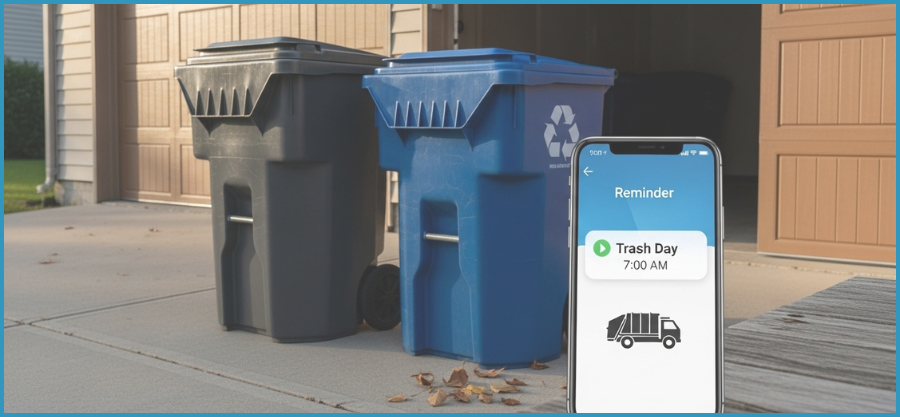
Build the reminder from the address-specific official schedule instead of assuming the same weekday year-round.
- Subscribe to the city’s text, email, app, or calendar reminder when available.
- Set one reminder before the official set-out window and another for cart retrieval.
- Add official holiday and service-delay notices rather than applying a universal one-day shift.
- Assign one person and one backup for each collection.
- Keep the cart placement area clear of cars, gates, branches, mailboxes, meters, and other obstructions required by the local rules.
- Review capacity. If the lid routinely will not close, ask the provider about an additional cart, approved overflow, recycling, bulky collection, or a lawful material-specific program.
- Recheck the schedule after moving, changing providers, or receiving a new cart or service notice.
The 7:00 a.m. time shown in the illustration is only a graphic. Your official local set-out time controls.
What If You Miss Trash Day Regularly?
Repeated misses usually point to a schedule, capacity, placement, or responsibility problem. Review which one is failing:
- Schedule: Is the address calendar correct, including holidays and service changes?
- Reminder: Does it occur before the permitted set-out window?
- Responsibility: Is one person assigned, with a backup?
- Placement: Is the cart compliant, accessible, correctly oriented, and separated from obstacles?
- Capacity: Does the lid close with all permitted waste inside?
- Material: Are recycling, yard waste, bulky items, electronics, chemicals, or other restricted materials using the right program?
- Property type: Does the household actually use a city cart, or a private dumpster/hauler managed by an apartment, HOA, or commercial account?
Ask the provider about reminders, a larger or additional cart, authorized extra collection, accessibility assistance, or material-specific programs. Do not solve a recurring capacity issue with chronic overflow, illegal dumping, another person’s cart, or prohibited materials.
Turning a Missed Trash Day Into a Reset Opportunity
After the waste is collected or moved through an approved path:
- inspect the cart and storage area for visible leakage or residue;
- clean visibly dirty washable surfaces with a suitable detergent and follow material instructions;
- replace damaged bags only when it can be done without exposure to a restricted or unknown hazard;
- update the official calendar and reminders;
- record holiday, set-out, placement, and retrieval rules where the household can find them;
- label the difference between trash, recycling, yard waste, bulky items, and household hazardous waste; and
- request an additional cart or another approved service if ordinary capacity is consistently insufficient.
The goal is a compliant, repeatable system—not a claim that one cleaning product, deep clean, or junk-removal visit can prevent every future miss, odor, pest, spill, or municipal issue.
Frequently Asked Questions About Missing Trash Day
What should I do if I forgot to put the trash out?
Check the official address schedule and rules. A forgotten set-out usually is not a city missed collection. Return the cart to the approved storage location unless the provider directs otherwise, keep permitted waste tied and contained, and ask whether you must wait for the next regular pickup or may use an approved extra pickup, overflow, drop-off, or additional-cart option.
What if my cart was out correctly but the truck skipped it?
Check for a tag, obstruction, delay, holiday change, or neighborhood-wide issue. Wait until the city’s stated completion time, then use its official missed-collection process. Follow the instruction about whether to leave the cart out. Do not file a missed-collection request if the cart was late or noncompliant.
Can I leave the cart at the curb until the next pickup?
Not automatically. Cities and properties regulate when carts may be set out and retrieved. Some tell residents to leave a properly placed missed cart out while a request is pending; that is different from leaving a forgotten or noncompliant cart at the curb for a week. Follow the current local instruction.
Can I put extra bags beside the cart next week?
Only if the provider explicitly allows it. Allen, Garland, and Dallas, for example, state that ordinary extra bags should not be placed on or beside the regular cart. Other services may sell tags, schedule extra pickup, provide additional carts, or use a different rule. Verify the exact address and service.
Can I use my neighbor’s bin?
Do not assume so. You need the neighbor’s permission, enough legal capacity, and confirmation that the city, hauler, HOA, lease, and container rules allow it. Never add prohibited material or cause the lid to remain open.
What should I do about odor or a leaking bag?
Contain allowed ordinary waste in a tied bag and closed approved cart. For visible residue on a washable surface, avoid direct contact and clean with a surface-appropriate soap or detergent. Do not rely on vinegar, fragrance, baking soda, litter, charcoal, or another recipe as a guaranteed fix. Use specialist guidance for chemicals, sharps, medical waste, sewage, biohazards, pests, or unknown material.
What if collection changed because of a holiday or weather?
Use the current city or hauler notice. Do not assume every holiday shifts collection by one day or that every service receives a make-up day. Trash, recycling, yard waste, and bulky collection may be treated differently.
Can a junk-removal company take the overflow?
Only when the company confirms the exact items and is authorized to handle them. Junk removal may fit approved bulky furniture, appliances, debris, or clutter; it should not be assumed for routine weekly bags, household chemicals, batteries, paint, fuel, electronics, medical waste, biological material, sewage, liquids, or another restricted item.
